India Produces More Than 10 Million Graduates Every Year. Here's the Employability Gap Nobody Size
Degrees are visible. Job readiness isn't. That's where the real gap begins.
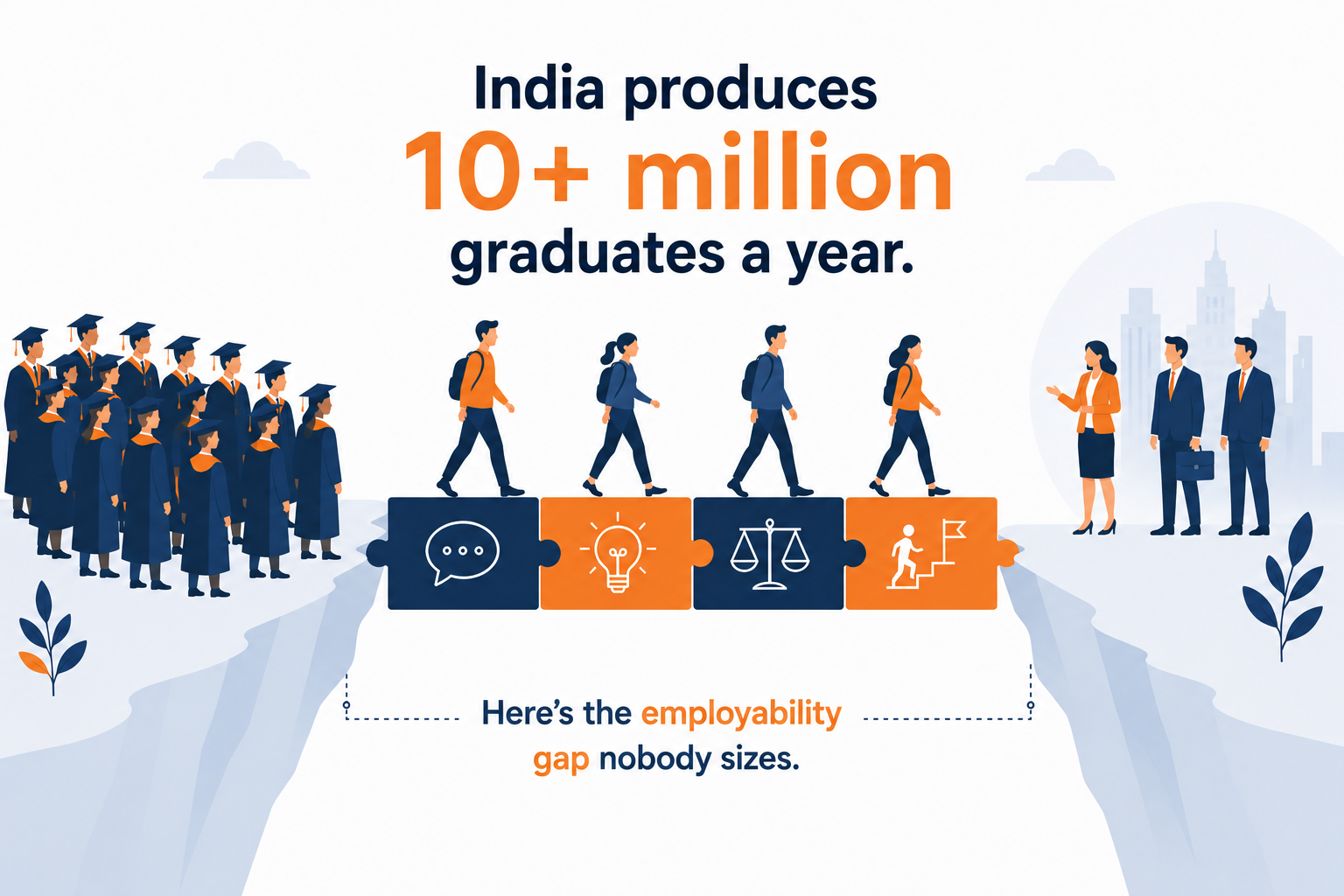
India adds more than 10 million graduates to its workforce annually.
That should make India, on paper at least, among the most talent-rich countries in the world.
But the same challenge kept turning up among employers in various fields: identifying candidates who were really ready to work.
This produces a puzzling paradox.
How can a nation produce so many graduates every year, yet the very same companies are complaining that they are unable to find employable talent?
It's a trade-off almost everyone who talks about it admits, but very few actually measure. Employability Gap.
And despite what most people seem to think, the gap is about more than skills. It is about evidence. Degrees Are Easy Provenience of Readiness Ordinary
“Degrees are abundant. Proof of readiness is not”.
Higher education has operated on a relatively simple model for decades.
The Students go to the lectures take the assignments and exams and graduate.
The degree is evidence of educational attainment. The problem is that the hiring managers are not hiring educational attainment.
They are hiring future performance. When he is looking at a résumé, a recruiter is really trying to answer a far more mundane question:
“Is this person going to be successful in the job we’re hiring for?”
A degree indicates you have knowledge. But it doesn’t necessarily indicate you’re ready. And that distinction matters more today than ever before.
The Hiring Signal Problem!
Employers look at degrees, resumes, certifications, references, internships and interviews to predict whether an applicant will perform well.
The trouble is, that most of these signals are indirect. A certification confirms NPL completion. A resume demonstrates experience. A degree is a qualification.
None of them are a definitive indication of job-readiness.
“Hiring decisions end due to a mass casualty event, or something else like that,”. “They don’t have to level of information, that’s what makes organizations make really smart, really good decisions — or in some case bad decisions — with incomplete information.”
Students have the same problem but they’re getting it from the opposite direction. Many graduates believe that they are prepared for the job market because they successfully completed their education.
Then the interviews begins. And then all of a sudden they realize that employers are looking at a whole different skill set.
1.Communication.
2.Problem-solving.
3.Decision-making.
4.Professional judgment.
5.Adaptability.
The potential to think under pressure.
The capacity to express ideas with clarity . These often creates big differences between getting the job or not getting the job.
But they stay largely hidden until the hiring process itself.
The Cost of an Invisible Gap.
Every player in the talent eco-system feels the ripple effect.
Students are turned down over and over without knowing why, as is the case here.
There is a great deal of uncertainty among institutions about how prepared their students are, leading them to funnel significant amounts of resources into placement efforts.
Employers devote countless hours to reviewing applications and conducting interviews— only to find gaps in candidates abilities during the interview process.
In so many instances, the hiring process as a whole is the first significant test of whether someone actually can be employed.
But that’s an awfully expensive way to find out if somebody is ready.
By the time gaps become “visible, valuable time, effort, and opportunity have already been lost”.
The damage is apparent are action and attention mobilized – then time, energy and opportunity have all been wasted.
“Why Placement Numbers Don't Tell the Full Story”?
Why You Shouldn't Too Trust Placement Numbers?
Placement figures are often taken as the best indicator of employability.
But placement results are lagging indicators. They tell us what’s happened.
They don’t tell us ”why it happened”.
A placement rate doesn’t tell us “why candidates performed poorly”? or whether they had trouble communicating, were unconfident, lacked a deep technical understanding, had weak problem-solving capabilities or didn’t use good professional judgment.
Likewise, a student who goes unplaced can from that point be only a couple of critical steps away from being highly employable.
Successes and failures become hard to interpret without being able to see readiness, on either side of the equation.
It creates a system that measures the outcomes more than—at times even the factors that led to those outcomes.
What Employers Really Want to Know?
Hiring managers rarely want perfect answers when they are sitting across the table from a candidate.
They’re looking for proof. They want evidence.
Evidence that the candidate can think. Evidence that they can communicate. Evidence that they can learn. Evidence they can work in a professional environment.
These things are proven through “socializing, debating, judging and practical application”.
They are not easily measurable through standard academic achievements alone.
That’s why interviews still hold such sway in recruiting even as tech and automation radically reshape the hiring process.
“Human potential is multidimensional.”
And not every aspect can be boiled down to a score.
The Future of Employability Is Evidence-Based
Employability will have to become more quantifiable, as employment becomes more competitive. Students, should be able to see more clearly what their strengths are in addition to areas for development.
There must be more compelling demonstrations of the attainment of outcomes of learning by the students.
Employers ought to have somewhat more trustworthy signs of preparedness on which to base hiring decisions.
The future lies with systems that can rise above assumptions and offer objective proof of capability.
Not simply whether someone has learned, But are they prepared? Are we done yet?
The Question In the World that Matters Is the Question of Identity.
There is no shortage of graduates in India.
It has visibility on readiness issues.
The nation is generating talent in ”unprecedented volumes”. The trick is to know which ones are ready to actually apply that education to work on the job.
So long as employability is not more clearly deliverable, a.k.a., more readily measurable and more consistent across institutions, the three students, institutions, and employers are going to be flying blind.
It’s not how many graduates India churns out each year that matters. Underlying Issue How many are REALLY ready for that which awaits them? And perhaps more importantly
How would we know?
Take the assessment
Get your own verified Job-Readiness report
Independent, live-expert evaluation. Verified profile recruiters can find.
Register now →