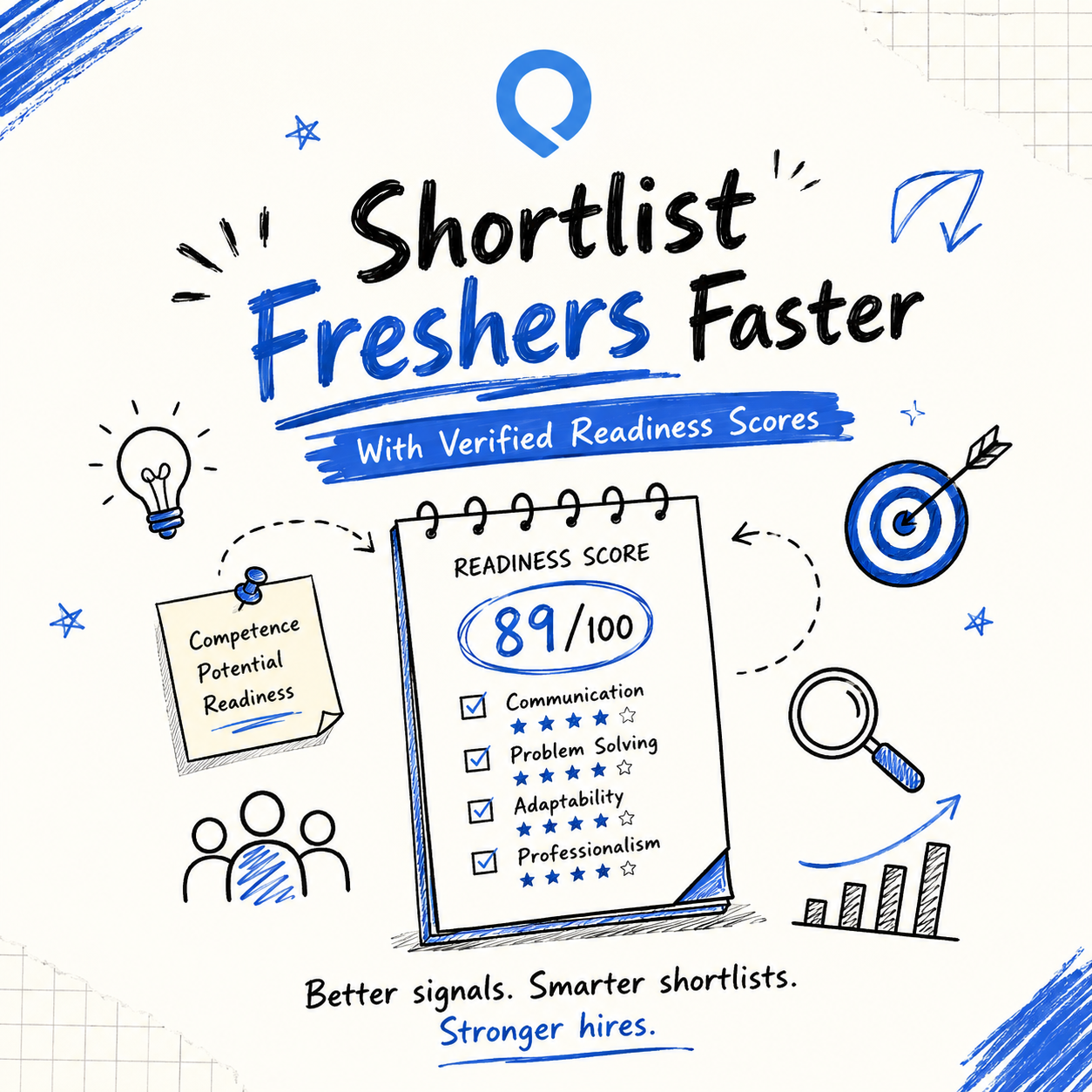
Shortlist freshers faster with verified readiness scores
Better signals. Smarter shortlists. Stronger hires.
From Résumé Screening to Readiness Screening
This is why organisations are looking beyond qualifications alone and increasingly paying attention to the skills that influence real workplace performance.
For hiring managers, the challenge is not simply figuring out whether a candidate possesses a particular skill.
It is being able to measure those skills consistently across a large number of candidates.
Traditional screening usually starts with a straightforward question:
> "Does this applicant qualify?"
A better question for employers is:
> "What evidence do we have that this candidate is ready for the role?"
That distinction matters.
Eligibility can be established through a degree, percentage, certification, or another formal criterion. Readiness is broader. It can include communication, critical thinking, problem-solving, professional conduct, adaptability, and the ability to apply knowledge rather than simply recall it.
A structured readiness evaluation can add another dimension to the hiring process by providing a more consistent way to assess candidates beyond what appears on their résumés.
Rather than asking recruiters to infer workplace readiness from limited information, the goal is to generate measurable signals that can support better shortlisting decisions.
What a Readiness Score Should Tell a Recruiter
A score is valuable only when it means something.
A good readiness score should not simply become another number attached to a candidate's profile. It should give recruiters insight into why a candidate received that score and which competencies contributed to it.
For example, two candidates may have similar overall scores while demonstrating very different strengths.
One might be an excellent communicator but need to develop their analytical thinking.
Another might demonstrate strong problem-solving skills but have difficulty communicating their ideas clearly.
Looking at these competency-level insights gives recruiters more context than a single percentage or ranking.
It also allows organisations to maintain a more holistic view of candidates while keeping the screening process structured and consistent.
The objective is not to reduce a candidate to a number. It is to give recruiters better evidence to work with before making a hiring decision.
Purpose of a Verified Readiness Score
A readiness score is only valuable when it measures the skills that genuinely matter in the workplace.
For freshers, this means looking beyond academic scores and understanding how they communicate, think, adapt, and respond to situations outside the classroom.
Communication and Clarity
A candidate may have the right qualifications but still struggle to explain an idea clearly.
A functional readiness evaluation can indicate whether a candidate can organise their thoughts, communicate effectively, listen attentively, and respond appropriately in professional situations.
These signals can be especially useful when recruiters need to distinguish between candidates with similar educational backgrounds.
Critical Thinking and Problem-Solving
Work rarely comes with perfectly defined questions or textbook answers.
Employers want people who can understand a situation, identify the problem, consider possible solutions, and explain why they chose a particular approach.
Assessing these skills gives recruiters another perspective on how candidates may respond when they encounter unfamiliar situations at work.
Adaptability and Learning Agility
Freshers cannot be expected to know every process, tool, or business situation before joining an organisation.
What matters is how quickly they can learn, respond to feedback, and adapt when circumstances change.
A candidate who demonstrates curiosity and a genuine desire to improve may have significant potential even without extensive professional experience.
Professional Behaviour
Workplace readiness also extends to how candidates conduct themselves.
Professional communication, accountability, teamwork, and the ability to respond appropriately to different situations can influence how effectively a new employee works within a team.
These qualities may not appear on a résumé, but they can become increasingly important once a candidate enters the workplace.
Why Competency-Level Insights Matter
An overall score can provide a quick comparison, but the real value lies in understanding what sits behind that score.
Two candidates might receive similar overall scores while demonstrating very different strengths.
One might be a strong communicator who needs to develop their analytical thinking. Another might demonstrate excellent critical-thinking skills but require support in professional communication.
For recruiters, these differences provide valuable context.
Instead of simply asking:
> "Who scored higher?"
organisations can begin asking:
> "Which candidate demonstrates the competencies this role actually requires?"
That shift can make readiness scores more useful during the shortlisting process while still leaving the final hiring decision to human judgement.
From Readiness Scores to Better Shortlists
A readiness score should not take the place of a recruiter's judgement. It should serve to inform that judgement.
For organisations that recruit freshers in large numbers, one of the key benefits of a structured readiness assessment is that it can provide an additional layer of evidence before the interview stage.
Rather than relying purely on academic grades or résumé-based filtering, recruiters can use competency-level outcomes to identify candidates whose skills are more closely aligned with the requirements of a particular role.
Bringing More Consistency to Shortlisting
When hundreds of applications arrive for a single position, consistency becomes increasingly important.
Résumés can also vary widely in how they present candidates. Some students have numerous certifications and polished profiles, while others may have strong capabilities that do not come across as effectively on paper.
A readiness score can provide recruiters with a common lens through which to evaluate candidates.
It does not reduce the need for human judgement. Instead, it can help recruiters determine where to apply that judgement first.
Candidates who demonstrate relevant competencies can be moved forward for deeper evaluation, while assessment results can also highlight areas that may be worth exploring during an interview.
Verified Does Not Mean Automated
Having a score is not the same as having a reliable assessment behind that score.
For a readiness score to provide value in hiring, an organisation needs to understand how it was derived, which competencies were measured, and whether the same assessment process was applied consistently across candidates.
This is where structured, independently assessed evaluations can add value.
Rather than candidates or organisations assessing their own readiness, an independent third-party evaluation can provide an external perspective on the competencies being assessed.
The goal is not to turn hiring into a numbers game.
It is to give recruiters better evidence before making a decision.
Where Human Judgement Still Matters
No score can tell a recruiter everything they need to know about a candidate.
A readiness assessment can provide useful signals, but recruiters still need to consider factors such as role requirements, team fit, experience, motivation, and the context behind a candidate's achievements.
The strongest hiring process therefore combines structured evidence with human judgement.
The assessment helps answer:
> "What does the evidence tell us about this candidate's preparedness?"
The recruiter then decides:
> "What does this mean for this particular role?"
That distinction is critical because assessment should support recruitment—not make the recruitment decision itself.
A Better Way to Think About Fresher Hiring
Fresher hiring should not simply be about identifying candidates who look impressive on paper.
The goal should be to identify candidates with the ability, attitude, and potential to grow into capable professionals.
Verified readiness scores can contribute to that process by providing recruiters with another layer of structured information, particularly when large candidate pools make traditional screening difficult.
For candidates, the same process can provide something equally valuable: insight into their own strengths and areas for improvement.
That makes readiness assessment useful on both sides of the hiring process.
Conclusion
There will always be an element of uncertainty when hiring freshers. No résumé, interview, or assessment can completely predict how an individual will perform after joining an organisation.
But better evidence can reduce some of that uncertainty.
Educational qualifications show what a candidate has achieved academically. A résumé shows how they present their experiences. An interview reveals how they communicate and respond in a particular interaction.
A structured readiness assessment can provide an additional perspective by showing how a candidate demonstrates competencies that matter in the workplace.
For recruiters, this can support more informed shortlisting, greater consistency, and a clearer understanding of candidate strengths before the final hiring decision.
For freshers, it can provide a more complete picture of their potential beyond marks and qualifications.
The goal is simple:
> Don't just identify candidates who look ready. Build a process that helps you understand why they're ready.
For organisations looking to bring greater structure and evidence into fresher hiring, GII QUEST™ provides an independent, human-assessed approach to evaluating workplace readiness across key employability competencies.
Key Takeaways
A readiness score should supplement, not replace, human judgement.
Competency-level results can provide more context than a single overall score.
Structured assessments can bring greater consistency to high-volume fresher screening.
Independent evaluation can add another layer of credibility to readiness outcomes.
The objective is not simply to find candidates who look ready, but to understand why they are ready.
Take the assessment
Get your own verified Job-Readiness report
Independent, live-expert evaluation. Verified profile recruiters can find.
Register now →