Skills-First Hiring in India: What It Means for Students and Institutes
Beyond Degrees. Towards Capability.
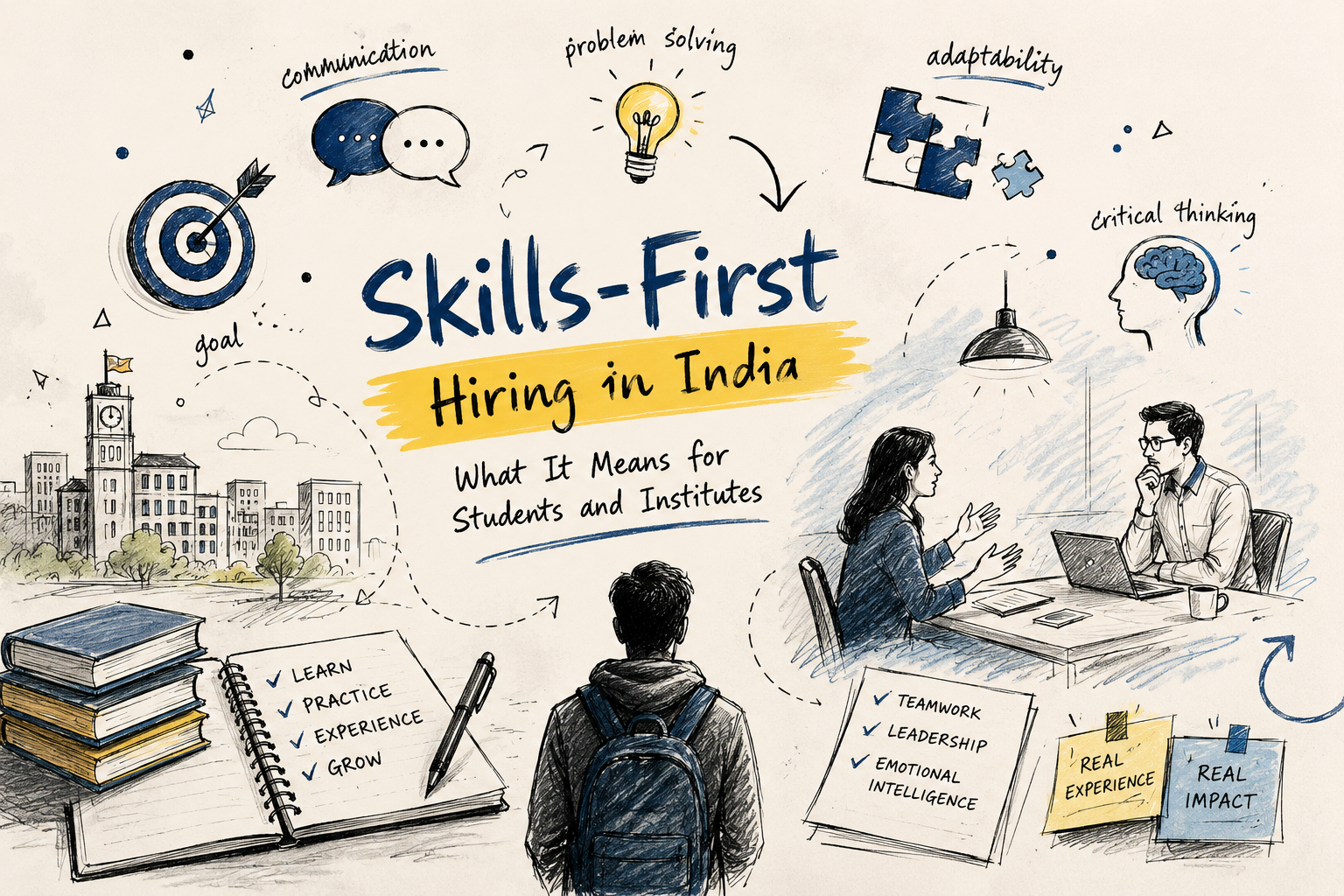
The Degree Isn't Going Away—The Hiring Process Is Evolving
Imagine two graduates applying for the same job.
The first candidate has an outstanding academic record.
A high GPA.
A prestigious university.
Multiple certifications.
The second candidate looks just as qualified on paper.
But during the interview, they confidently explain how they solved problems during an internship, collaborated with different teams, handled unexpected situations, and learned from their mistakes.
Both graduates meet the eligibility criteria.
Both have the required qualifications.
Yet only one receives the job offer.
Increasingly, that difference isn't determined by grades alone.
It's determined by how well candidates demonstrate workplace skills.
Hiring across India is gradually evolving.
Degrees still matter.
Knowledge still matters.
Technical expertise still matters.
But employers are now asking one additional question:
> Can this candidate apply what they've learned in the real world?
This shift is commonly known as skills-first hiring.
Instead of evaluating qualifications alone, employers are increasingly looking at practical experience, communication, problem-solving, adaptability, and how quickly someone can contribute from Day 1.
For students, this changes what career success looks like.
For educational institutions, it changes how employability needs to be developed—and measured.
Why Employers Are Looking Beyond Degrees
For many years, academic qualifications were among the strongest indicators of potential.
Degrees represented commitment.
They reflected knowledge.
They helped employers narrow large pools of applicants.
That hasn't changed entirely.
Educational qualifications remain an important screening criterion for many organisations.
However, employers are increasingly recognising that academic excellence doesn't always translate into workplace success.
A graduate may perform exceptionally well in examinations but struggle to communicate with colleagues.
Another may possess strong technical knowledge but find it difficult to solve unfamiliar problems under pressure.
Someone else may have excellent grades yet lack the confidence to present ideas or interact with clients.
These aren't academic shortcomings.
They're workplace capabilities.
As organisations become more dynamic and technology continues to reshape the world of work, adaptability has become just as valuable as technical expertise.
Businesses need people who can learn continuously, collaborate across teams, and respond confidently to new challenges.
Those qualities are difficult to measure through academic transcripts alone.
That's why recruitment is shifting from asking:
> "What qualifications does this candidate have?"
to asking:
> "What can this candidate actually do?"
The Rise of Skills-First Hiring
Skills-first hiring doesn't mean qualifications have lost their value.
Instead, it broadens the way employers evaluate talent.
Rather than relying only on academic credentials, organisations assess a wider combination of knowledge, behaviour, practical capability, and workplace readiness.
That means asking questions like:
- Can the candidate communicate clearly?
- Can they solve problems independently?
- How well do they work with others?
- Can they adapt to change?
- Are they willing to keep learning?
- Can they apply their knowledge in real workplace situations?
These questions help employers understand not only what candidates know, but how effectively they'll perform once they join the organisation.
For employers, this reduces uncertainty.
For students, it creates opportunities to stand out beyond grades alone.
For educational institutions, it reinforces the importance of preparing learners for careers—not just examinations.
The conversation around employability is changing.
Success is becoming less about collecting credentials and more about demonstrating capability.
> Degrees may open the door.
> Skills determine what happens next.
And that shift is reshaping recruitment across industries in India.
What the Skills-First Hiring Trend Means for Students
Skills-first hiring is changing the way many students prepare for their careers.
For years, academic success was considered the primary pathway to employment.
Study hard.
Earn good marks.
Graduate.
Get hired.
While academic performance still matters, today's hiring landscape expects something more.
Students are increasingly expected to demonstrate how they think, communicate, solve problems, and adapt to new situations.
That doesn't mean everyone needs years of work experience before graduating.
It means employers want evidence that graduates can apply what they've learned beyond the classroom.
That evidence can come from many different experiences.
- Internships
- Live projects
- Case competitions
- Volunteering
- Leadership roles
- Freelance work
- Student clubs
Even small opportunities that require teamwork, communication, and decision-making help students build workplace confidence.
Increasingly, employers aren't only asking:
> "What did you study?"
They're also asking:
> "What have you done with what you learned?"
That simple shift changes how students should approach their education.
A degree is no longer the finish line.
It's the foundation.
The experiences built alongside it often become the strongest indicators of employability.
The New Skills Employers Value Most
Technical knowledge remains essential.
An engineer still needs engineering skills.
A marketer still needs marketing knowledge.
A software developer still needs programming ability.
But technical expertise alone rarely determines hiring decisions.
Employers are increasingly valuing the skills that influence day-to-day workplace performance, including:
- Communication
- Critical thinking
- Problem-solving
- Adaptability
- Collaboration
- Professional behaviour
- Time management
- Emotional intelligence
- Curiosity
- Continuous learning
These skills allow employees to contribute effectively regardless of the role they perform.
Technology changes rapidly.
Software evolves.
Industries transform.
Employees who continue learning and adapting remain valuable long after graduation.
That's one reason organisations increasingly describe these as future-ready skills.
While technical knowledge may become outdated, workplace capabilities remain valuable across industries and throughout careers.
Employers aren't just hiring for today's requirements.
They're hiring for tomorrow's potential.
Why Educational Institutions Need to Adapt
This shift isn't affecting only students.
It's also changing expectations for educational institutions.
For many years, success was measured primarily through academic performance.
Examinations.
Grades.
Pass percentages.
Placement numbers.
These metrics still matter.
But they don't always explain how well students are prepared for professional life.
Institutions now have an opportunity to broaden the way employability is developed.
Instead of focusing exclusively on technical learning, they can create more opportunities for students to build workplace capabilities.
This might include:
- Project-based learning
- Industry exposure
- Group assignments
- Presentations
- Mock interviews
- Case studies
- Practical assessments
- Structured feedback
These experiences help students bridge the gap between classroom learning and workplace expectations.
Educational institutions are increasingly expected to do more than produce graduates.
They're expected to prepare graduates who can thrive in modern workplaces.
> Preparing students for examinations is important.
> Preparing them for employment is essential.
That represents one of the biggest shifts taking place in higher education today.
Why Meaningful Assessment Matters More Than Ever
As skills-first hiring continues to grow, one challenge becomes increasingly important.
How can employers be confident that candidates genuinely possess the skills listed on their résumés?
A degree confirms that a student has completed a programme.
A certificate may confirm that a course was finished.
But neither always explains how well someone will perform in a real workplace.
That's why assessment is becoming more important than ever.
Not simply measuring knowledge.
But measuring capability.
Can the candidate communicate clearly?
Can they solve unfamiliar problems?
Can they collaborate effectively?
Can they adapt to changing situations?
Do they demonstrate professionalism?
These are the questions employers increasingly want answered before making hiring decisions.
For students, meaningful assessment offers much more than a score.
It provides direction.
They understand where they're performing well.
They identify the skills that need further development.
They approach interviews with greater confidence because they know where they stand.
> Assessment isn't the end of learning.
> It's an essential part of the learning journey.
Building Employability Through Evidence
The conversation around employability is evolving.
Educational institutions are no longer expected to simply deliver academic knowledge.
Increasingly, they're expected to demonstrate that students are developing workplace capabilities throughout their learning journey.
Evidence is becoming more valuable than assumptions.
Rather than saying students are job-ready, institutions now have the opportunity to demonstrate how readiness has been assessed.
Rather than relying only on placement percentages, they can show the skills students have developed before entering the workforce.
That creates value for everyone involved.
- Students gain a clearer understanding of their strengths.
- Parents develop greater confidence in the institution's approach.
- Employers receive stronger evidence of candidate readiness.
- Educational institutions strengthen the credibility of their employability outcomes.
The goal isn't to replace academic learning.
It's to complement it with meaningful evidence of workplace readiness.
Looking Ahead
The future of hiring in India is unlikely to be defined by degrees alone.
Nor will it be determined solely by technical expertise.
Increasingly, organisations will look for people who combine knowledge with communication, adaptability, professionalism, and the ability to solve real-world problems.
That creates both a challenge and an opportunity.
Students have the opportunity to develop skills that help them stand out beyond academic results.
Educational institutions have the opportunity to prepare graduates who are ready not only to secure jobs—but to succeed in them.
Employers have the opportunity to make hiring decisions based on stronger evidence of capability rather than assumptions alone.
Skills-first hiring isn't about reducing the value of education.
It's about expanding the definition of what it means to be career-ready.
Because in the future, success won't be determined only by what someone knows.
It will increasingly be determined by what they can do with that knowledge.
> Degrees may open opportunities.
> Skills build careers.
> Evidence builds trust.
Take the assessment
Get your own verified Job-Readiness report
Meet a professional from your field and get feedback on what to work on before your next interview.
Register now →