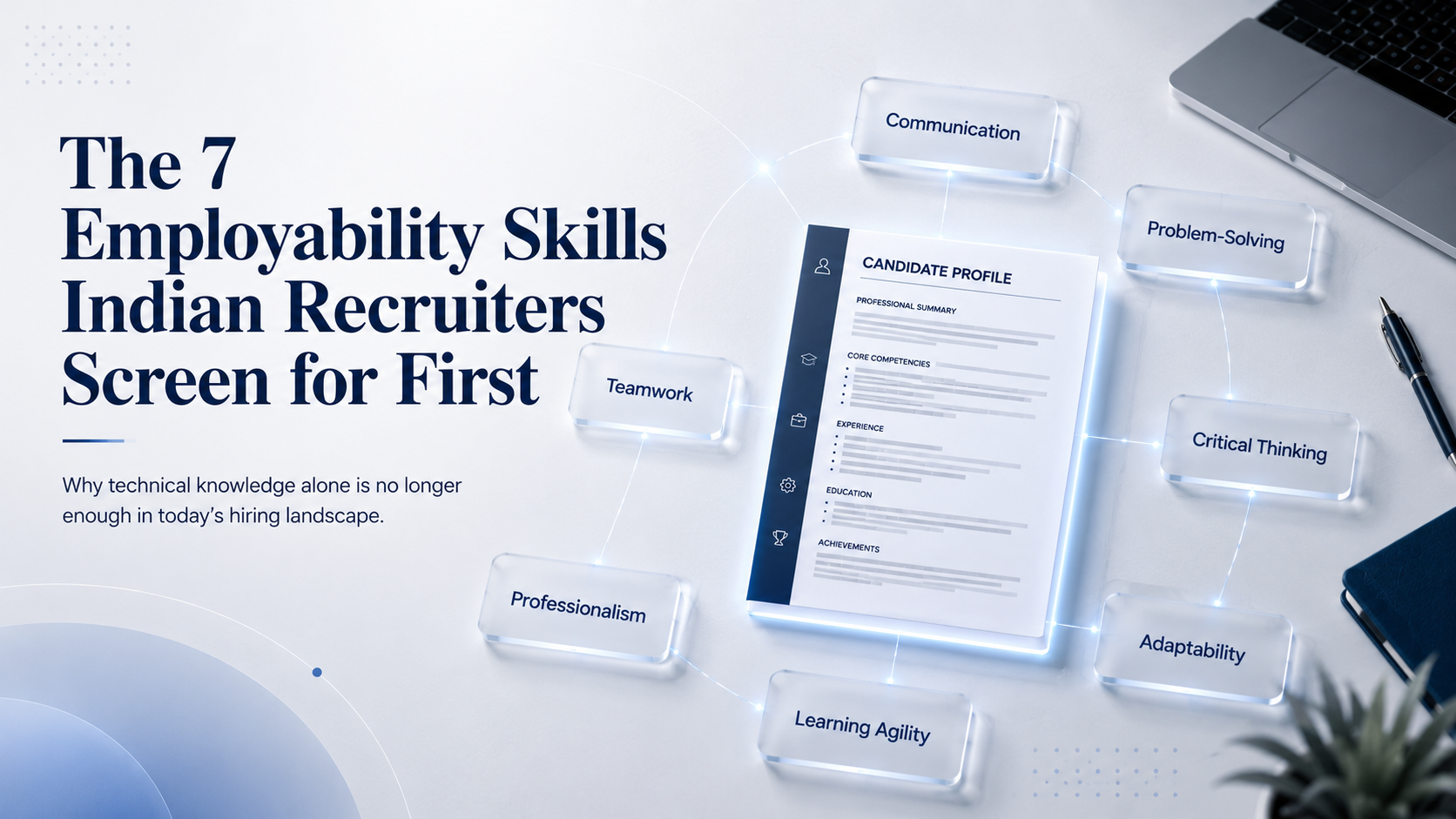
The 7 Employability Skills Indian Recruiters Screen for First
Why technical knowledge alone is no longer enough in today's hiring landscape.
What Recruiters See Before They See Your Resume
A graduate walks into an interview with great academic score, related certifications, and a plagiarized resume.
Another candidate comes in with similar qualifications, but is confident, articulate, engaging, makes sense, approaches problem in a logical manner, and changes on the fly quite naturally in a second conversation.
Who gets pushed off the field?
Recruiters are increasingly asking themselves that question as they go beyond qualifications to answer it.
In the tight job market, having the right technical skills may get candidates an interview, but their ability to communicate, collaborate, think critically and respond in real-time to workplace scenarios will often determine whether they get hired.
As organisations adopt a skills-first approach to hiring, employers are increasingly focused on the traits that differentiate those who can hit the ground running.
So, what are they really looking for?
Here are the seven employability skills that tend to make the greatest difference when hiring for any position.
1. Communication
The ability to communicate ideas effectively continues to be one of the most desirable skills in the workplace.
Recruiters take notice of the way candidates describe projects, respond to questions, engage in active listening and all other aspects of communication in the interview and hiring process.
2. Problem-Solving
There are no predefined answers when employees encounter obstacles at work – they have to be a little creative.
Recruiters want to know not only that a candidate recognizes a problem, but also how the person wants to solve it.
Those who can think through a situation, weigh alternative courses of action, and come to a considered conclusion are often valuable assets from day one.
From dealing with a customer complaint to working to a project deadline to tackling an unforeseen problem, problem solving can show up a candidate's ability to keep calm and take charge when the pressure is on.
3. Critical Thinking
Employers are increasingly looking for candidates who can think for themselves - not just follow instructions.
Critical thinking is the process of actively and skilfully conceptualizing, applying, analysing, synthesizing, and evaluating information to reach an answer or conclusion.
During interviews, recruiters may test your analytic abilities by giving you situational problems or asking you to discuss the logic behind your choices.
Applicants with the ability to think logically and soundly are also more likely to succeed in situations where they need to quickly adapt to unexpected changes within the workplace.
4. Adaptability
The workplace of the future is continuously changing, as new technologies, shifting business priorities and fluid work settings are becoming standard.
This means that out of an applicant pool, hiring managers want to see that potential employees can adapt to change, learn on the fly and still be productive with the unknown.
Adaptability demonstrates resilience, flexibility, and the readiness to keep evolving — attributes that are increasingly becoming necessary for most sectors.
5. Teamwork & Collaboration
Very few positions today call for employees to work alone.
Job applicants that demonstrate an ability to collaborate with other employees, regardless of their background, take responsibilities, respect different views, and work towards common objectives are what recruiters are looking for.
Effective teamwork is a sign of emotional intelligence, cooperation, and positive working relationships and all are vital aspects of service in today’s business environment.
6. Professionalism
Professionalism isn't just about knowing how to dress for an interview.
Recruiters and hiring managers watch for signs of a candidate's time management skills, attitude, level of responsibility, honesty, work ethics and general behavior during the entire recruitment process.
Candidates who show professionalism in the workplace gain the confidence of employers and are more likely to be trusted to represent an organisation responsibly.
7. Learning Agility
The continuous evolution of industries highlights continuous learning as a key skill for employability.
Hiring managers are increasingly seeking candidates who display intellectual curiosity, who are open to feedback, who can acquire new skills, and who can adjust to evolving business needs.
Learning gility signals a growth mindset and indicates the candidate is not only ready for today’s role, but also for what lies ahead.
Why These Skills Are Important?
Technical knowledge might get candidates an interview, but it’s not enough to make them employable.
Communication, problem-solving, critical thinking, teamwork, adaptability, professionalism, and lifelong learning are skills that allow people to make a difference in the workplace from day one.
As companies keep adopting skills-first hiring, these skills are now considered as important as the educational qualifications themselves.
Is It Possible To Learn These Skills?
Absolutely. Employability, on the other hand, is a skill that is honed through lifelong education, experience, knowledge, exposure to practical world, and feedback from real life situations.
Students can enhance these skills by:
Participating in live projects and internships.
Engaging in group discussions and presentations.
Applying case studies and problem-solving exercises.
Getting feedback frequently from mentors and industry professionals.
Doing mock interviews and workplace simulations.
Cultivate the route of lifelong learning.
The more students begin to cultivate those abilities early on, the more confident and ready they will be when they hit the job market.
The Importance of Job-Readiness
Evaluations With recruitment ever more moving towards skills-first hiring, evaluating employability goes beyond assessing academic knowledge.
Career-ready assessments allow students to assess their own strengths and weaknesses, and prepare more effectively to enter professional careers.
For institutions of learning, these tests can serve as a useful indicator of the overall readiness of students, as well as potential areas for focused skill enhancement.
For employers, a structured evaluation provides an additional tangible proof of an individual’s work readiness beyond resumes, educational credentials, and interviews.
Looking Ahead
The notion of what will make a graduate employable in the future will be determined not simply by the degree to which they know, but by how well they can ‘do’ their knowledge in actual workplace situations.
Although technical knowledge is still important, the skills that define successful candidates are increasingly: communication, problem-solving, adaptability, teamwork, professionalism, critical thinking, and learning agility.
With recruiting trends evolving, students who take the time to hone these employability skills will be better equipped to flourish in a workforce that will be even more challenging to compete in.
Take the assessment
Get your own verified Job-Readiness report
Independent, live-expert evaluation. Verified profile recruiters can find.
Register now →