The Interview Skills No One Teaches You in College
What recruiters really evaluate.
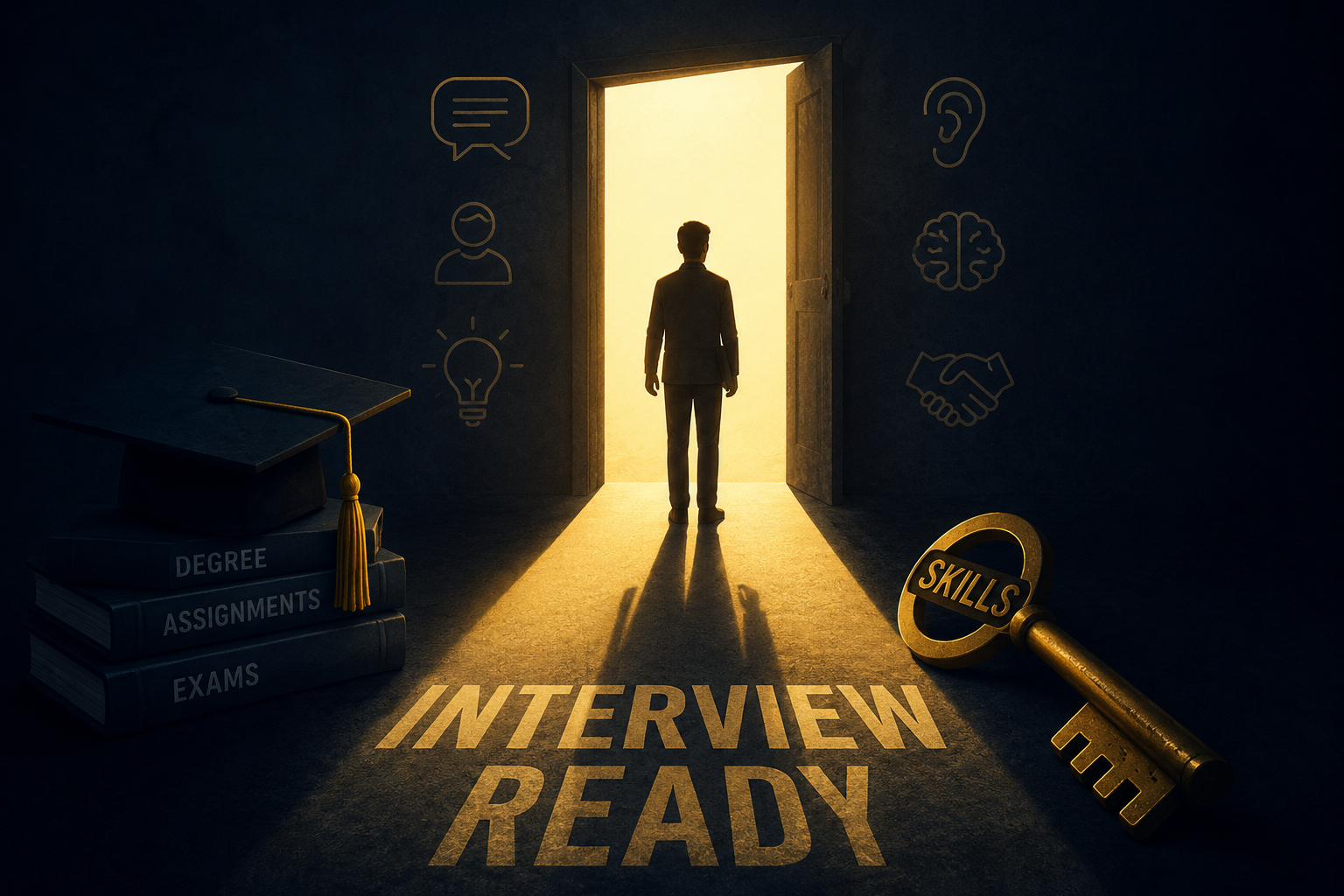
College Prepares You for Exams—Not Interviews
For most students, college is filled with years of examinations, assignments, and projects. They learn theories, complete practicals, and work hard to achieve good grades. While these accomplishments are important, many graduates are surprised to discover that performing well in an interview requires an entirely different set of skills.
Interviews Go Beyond Technical Knowledge
Interviews are not just about what you know. They give employers an opportunity to understand how you think, communicate, approach problems, find solutions, and present yourself in a professional setting.
Two candidates with similar qualifications can leave completely different impressions simply because of the way they answer questions and interact with the interviewer.
The Gap Colleges Often Leave Behind
The challenge is that colleges often focus heavily on academic knowledge while spending very little time preparing students for real interview situations.
As a result, many fresh graduates walk into their first interview feeling nervous, relying on memorized answers, or struggling to explain their experiences with confidence.
The Good News
Interview skills are not something people are born with—they can be learned and strengthened through consistent practice.
By understanding what interviewers are actually looking for, students can approach interviews with greater confidence and significantly improve their chances of success.
In this article, we'll explore the interview skills that are rarely taught in classrooms but are highly valued by recruiters, along with practical ways to develop them before your next interview.
The Skills Interviewers Notice Before They Notice Your Résumé
Many students believe interviews are designed to test their technical knowledge. While technical skills are important, they are rarely the first thing an interviewer evaluates.
Recruiters begin forming an opinion long before they discuss your qualifications. They observe how you communicate, listen, respond, and carry yourself throughout the conversation. These first impressions often influence the direction of the entire interview.
Here are some of the interview skills that can make a real difference.
Communication Is More Than Speaking Fluent English
One of the biggest misconceptions is that good communication means speaking perfect English or using complex vocabulary.
In reality, interviewers value clarity over complexity. They look for candidates who can express their thoughts confidently, organize their ideas logically, and communicate in a way that is easy to understand.
A clear and well-structured response is often far more effective than a lengthy answer filled with technical jargon.
Students can strengthen this skill by participating in mock interviews, recording themselves while answering common interview questions, and seeking honest feedback from mentors, professors, or friends.
Active Listening Is an Underrated Skill
Many candidates become so focused on preparing their next answer that they fail to fully understand the question being asked.
Strong interviewers notice candidates who listen carefully, pause to think, and respond thoughtfully instead of rushing into an answer.
Listening attentively also allows candidates to ask relevant follow-up questions or seek clarification when needed, demonstrating confidence rather than uncertainty.
Being an active listener reflects professionalism, patience, and respect for the conversation—qualities that employers value in every workplace.
Confidence Comes From Preparation, Not Memorisation
Many students prepare for interviews by memorising answers from websites or online videos.
The problem is that rehearsed answers often sound robotic and fail to reflect the candidate's genuine personality.
Instead of memorising responses, focus on understanding your own experiences. Think about your projects, internships, achievements, challenges, and the lessons you've learned from them.
When you speak from experience rather than memory, your answers become more authentic, engaging, and believable.
Employers Want to Understand Your Thought Process
Not every interview question has a single correct answer.
Recruiters often ask situational or unexpected questions to understand how you approach problems and make decisions.
Rather than rushing to find the "right" answer, explain your thought process. Walk the interviewer through your reasoning, consider different possibilities, and justify the decision you would make.
This demonstrates analytical thinking, problem-solving ability, and confidence under pressure—qualities that employers value across almost every profession.
Small Habits That Make a Big Difference
Interview success is rarely determined by one perfect answer. More often, it comes down to the small habits candidates develop long before they step into the interview room.
Simple actions such as researching the company, understanding the job description, arriving on time, dressing professionally, and carrying yourself with confidence can leave a lasting impression.
These habits demonstrate preparation, professionalism, and genuine interest in the opportunity—qualities that employers appreciate regardless of the role.
Learn to Tell Stories, Not Just List Achievements
One common mistake candidates make is listing their achievements without explaining the impact behind them.
Instead of saying:
> "I worked on a marketing project."
Explain what the project involved, the challenges you faced, the decisions you made, and the lessons you learned from the experience.
Storytelling allows interviewers to understand not only what you accomplished but also how you think, collaborate, and solve problems.
Real experiences are always more memorable than rehearsed responses.
Every Interview Is a Learning Opportunity
Not every interview will end with a job offer, and that's completely normal.
Every interview is an opportunity to learn. It helps you become more comfortable answering questions, communicating your ideas, and understanding what employers expect from candidates.
Instead of viewing unsuccessful interviews as failures, treat them as valuable learning experiences. Reflect on the questions you found challenging, identify areas where you can improve, and prepare more effectively for your next opportunity.
Candidates who continuously learn from each interview often become stronger professionals over time.
Interview Skills Improve With Practice
Interview success isn't based on talent alone. Like any professional skill, it improves through consistent practice, self-reflection, and constructive feedback.
Participating in mock interviews, seeking guidance from mentors, practicing real-life scenarios, and continuously improving your communication skills can significantly boost your confidence.
The goal isn't to deliver perfect answers—it's to communicate your thoughts honestly, clearly, and professionally.
Conclusion
A college degree provides the knowledge needed to begin a career, but interview skills help transform that knowledge into opportunity.
Employers aren't only looking for candidates who can answer technical questions. They also value individuals who can communicate effectively, think critically, solve problems, adapt to new situations, and present themselves with confidence.
The encouraging part is that these skills can be learned. With consistent practice, thoughtful preparation, and a willingness to learn from every experience, students can approach interviews with greater confidence and improve their chances of success.
For students who want a clearer understanding of their workplace readiness, structured assessments such as GII QUEST™ can help identify strengths, highlight areas for improvement, and support continuous professional development before entering the workforce.
Take the assessment
Get your own verified Job-Readiness report
Independent, live-expert evaluation. Verified profile recruiters can find.
Register now →