What Automated Proctoring Misses About Real Job Performance
Test integrity matters. But workplace readiness is the bigger picture.
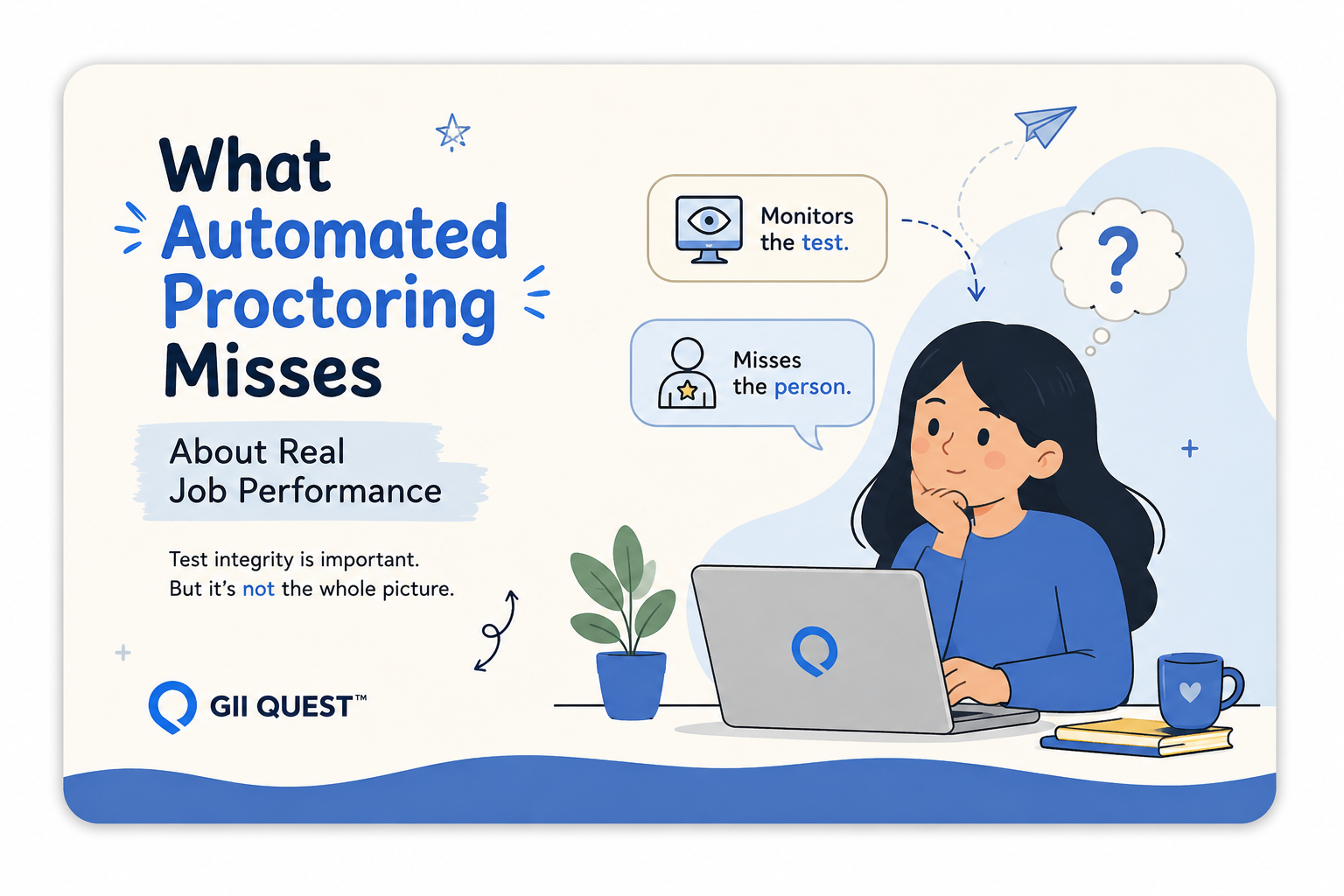
When Test Honesty Isn't Job Readiness
Automated proctoring is now a standard feature of many online assessments.
It can observe candidates while they take a test, raise a red flag over unusual activity, identify certain types of suspicious behaviour, and help organisations maintain the integrity of an examination. These can be useful features, especially when assessments are conducted at scale.
But there is a big difference that is often overlooked:
> A system can tell you if a candidate played by the rules of a test. It can't tell you what that person will be like as an employee.
That distinction becomes important when assessments are not simply testing academic knowledge, but are being used to understand whether a fresher is ready for a professional environment.
What Automated Proctoring Does Well
The goal of automated proctoring is primarily related to assessment integrity.
Depending on the technology being used, it may monitor things such as:
- Unusual movements or repeated behaviour
- More than one face appearing on camera
- Suspicious screen activity
- Attempts to copy or use unauthorised material
- Other actions that may violate assessment rules
This can make it easier to conduct remote evaluations, particularly when the number of candidates increases.
For a company assessing hundreds or thousands of candidates, automated monitoring can also reduce the amount of hands-on supervision required during the test.
In that sense, automated proctoring addresses an important question:
> "Was the test taken under the expected conditions?"
But that is only one part of the assessment.
The Question Proctoring Can't Answer
Imagine two candidates taking the same online test.
They both follow the instructions.
Neither triggers a proctoring warning.
They both finish the assessment within the allotted time.
From a test-integrity perspective, both assessments could be perfectly valid.
But what happens when those candidates enter a workplace?
Can they articulate their thinking?
Can they solve an unfamiliar problem?
Can they listen, ask relevant questions, and respond thoughtfully?
Can they adapt when things don't go as planned?
Can they work with people who approach a problem differently?
These are questions that proctoring cannot answer simply by observing a test environment.
They are questions of workplace readiness, not just assessment compliance.
From Monitoring Behaviour to Understanding Capability
This is where the difference between proctoring and assessment becomes important.
Proctoring is about preserving trust in the assessment environment.
A meaningful readiness assessment needs to look at what a candidate is actually capable of demonstrating during the assessment process.
The distinction can be summarised simply:
> Proctoring: "Has the candidate played by the rules?"
> Readiness assessment: "What can this candidate demonstrate?"
Both can have a place in modern assessment systems.
The mistake is assuming that one necessarily provides the evidence required by the other.
What Automated Proctoring Still Can't Measure
A candidate can complete an assessment honestly and still leave important questions unanswered.
This is because test integrity and workplace capability are not the same thing.
A monitored exam can provide evidence that a candidate completed the test under controlled conditions and did not violate the assessment rules. But once the goal is to understand how that candidate is likely to perform on the job, a broader set of skills needs to be considered.
Compliance Cannot Measure Communication
What can be observed during a test is not necessarily the same as the quality of a candidate's communication.
In the workplace, people do not communicate through multiple-choice questions.
They explain their ideas, justify decisions, raise questions, participate in conversations, present projects, and respond when someone challenges their thinking.
A candidate may perform well on a knowledge-based assessment but still have difficulty explaining how they arrived at an answer.
That distinction matters to employers.
Knowing something and being able to communicate what you know are not necessarily the same skill.
A readiness-oriented assessment therefore needs to create opportunities to observe how candidates express and organise their thoughts.
Problem-Solving Is About More Than Getting the Answer
Real-world jobs involve real-world problems.
Workplace problems are often incomplete. The information may not be clear, there may be several possible solutions, and priorities can change halfway through a task.
In these situations, employers want to understand more than whether a candidate reaches the expected answer.
They want to know:
- Can the candidate identify what actually matters?
- Can they work out what information they need?
- Can they consider alternative approaches?
- Can they explain their line of thought?
- Do they have a different approach if the first one fails?
These behaviours provide a very different signal from simply knowing whether a candidate completed a test without breaking its rules.
Adaptability Is Difficult to Capture in a Fixed Test Environment
Workplaces rarely remain exactly as planned.
A deadline gets postponed. A requirement changes. A client misunderstands something. A team has to rethink its approach.
Freshers, in particular, cannot be expected to have encountered every situation their first job might present.
What employers can look for instead is whether candidates can learn, respond to feedback, change their approach, and remain productive when circumstances change.
These qualities are difficult to understand from proctoring data alone.
Professional Behaviour Exists Beyond the Test Window
Workplace readiness also includes behaviours that may not appear during a traditional online assessment.
How does a candidate respond when asked to explain something?
Do they listen before answering?
Can they communicate respectfully with others?
Can they acknowledge when they do not know something?
Can they accept feedback without becoming defensive?
None of these are violations that need to be detected.
They are capabilities that need to be understood.
Technology Should Support Assessment, Not Define It
This does not mean automated proctoring has no value.
It can play an important role in maintaining assessment integrity, particularly when organisations need to assess large numbers of candidates remotely.
The problem arises when proctoring is assumed to provide a complete picture of candidate preparedness.
A more robust assessment strategy can use technology where it makes sense while also creating opportunities to evaluate the human capabilities that matter in a professional environment.
The goal is not to choose between technology and human assessment.
They should be used for what each does best. # Building a Better Assessment Approach
The answer is not to remove technology from assessments.
It is to understand where technology adds value and where human assessment is still necessary.
Automated systems can help organisations manage large candidate pools, maintain assessment integrity, and identify certain forms of unusual behaviour. But understanding workplace readiness requires looking at capabilities that cannot always be captured through automated monitoring alone.
Combine Technology With Human Assessment
A stronger assessment approach can bring together the strengths of both.
Technology can help make assessments scalable and consistent.
Human assessment can provide context around how a candidate communicates, reasons, responds, and approaches realistic situations.
Together, they can provide a more complete picture than either approach on its own.
The objective is not to make assessment more complicated.
It is to make the information it produces more useful for the decision that comes afterwards.
Assess What the Role Actually Requires
Not every role requires the same combination of skills.
A sales position may place greater emphasis on communication, persuasion, listening, and adaptability.
A technical role may require stronger analytical thinking and problem-solving.
A leadership-track position may require communication, decision-making, collaboration, and professional judgement.
This means a readiness assessment should not simply produce a generic score without context.
Recruiters need to understand which competencies were assessed and how those competencies relate to the role.
From Suspicion Signals to Capability Signals
There is a difference between identifying something that may be wrong with a test and identifying something that may be valuable in a candidate.
A proctoring system may bring suspicious activity to light.
A readiness assessment can look for evidence of capability.
One focuses on assessment integrity.
The other focuses on candidate readiness.
Keeping these two goals separate can help organisations interpret assessment results more accurately and avoid expecting one system to answer questions it was never designed to answer.
Why This Matters for Fresher Hiring
The challenge becomes even more important when organisations recruit a large number of fresh graduates.
Fresh graduates tend to have limited professional experience, which means recruiters often have fewer workplace examples to evaluate.
Their résumés may look similar.
Their academic qualifications may be comparable.
Their professional experience may be limited.
This makes trustworthy assessment signals even more important.
A structured readiness assessment can give recruiters additional evidence about a candidate's strengths and the areas that may need further attention during the hiring process.
It can also give candidates something that a simple pass-or-fail result cannot provide:
a better understanding of what they are already able to demonstrate and where they may need to improve.
Conclusion
Automated proctoring has an important place in modern assessments.
It can help maintain test integrity, support remote testing, and make large-scale assessments more manageable.
But test integrity isn't workplace readiness.
A candidate can follow all the rules during an assessment and still leave important questions unanswered about how they communicate, solve problems, adapt, collaborate, or handle real-world situations.
That is why the future of assessment should not be about adopting technology at the expense of human judgement.
It is about using both effectively.
> Technology can help us trust the assessment. Human assessment can help us understand the candidate.
For organisations seeking a more comprehensive view of fresh graduate preparedness, GII QUEST™ offers an independent, human-assessed approach to evaluating critical employability skills.
Key Takeaways
- Automated proctoring primarily supports assessment integrity; it should not be treated as a complete measure of workplace readiness.
- Communication, problem-solving, adaptability, and professionalism need to be assessed in a broader context.
- Technology and human assessment can complement each other.
- The strongest assessment approach focuses on the competencies relevant to the role and workplace, rather than only what can be observed during a test.
Take the assessment
Get your own verified Job-Readiness report
Independent, live-expert evaluation. Verified profile recruiters can find.
Register now →